BRIM-005 rung 2 — the rung where the bind becomes likelier than the seat
What this part is
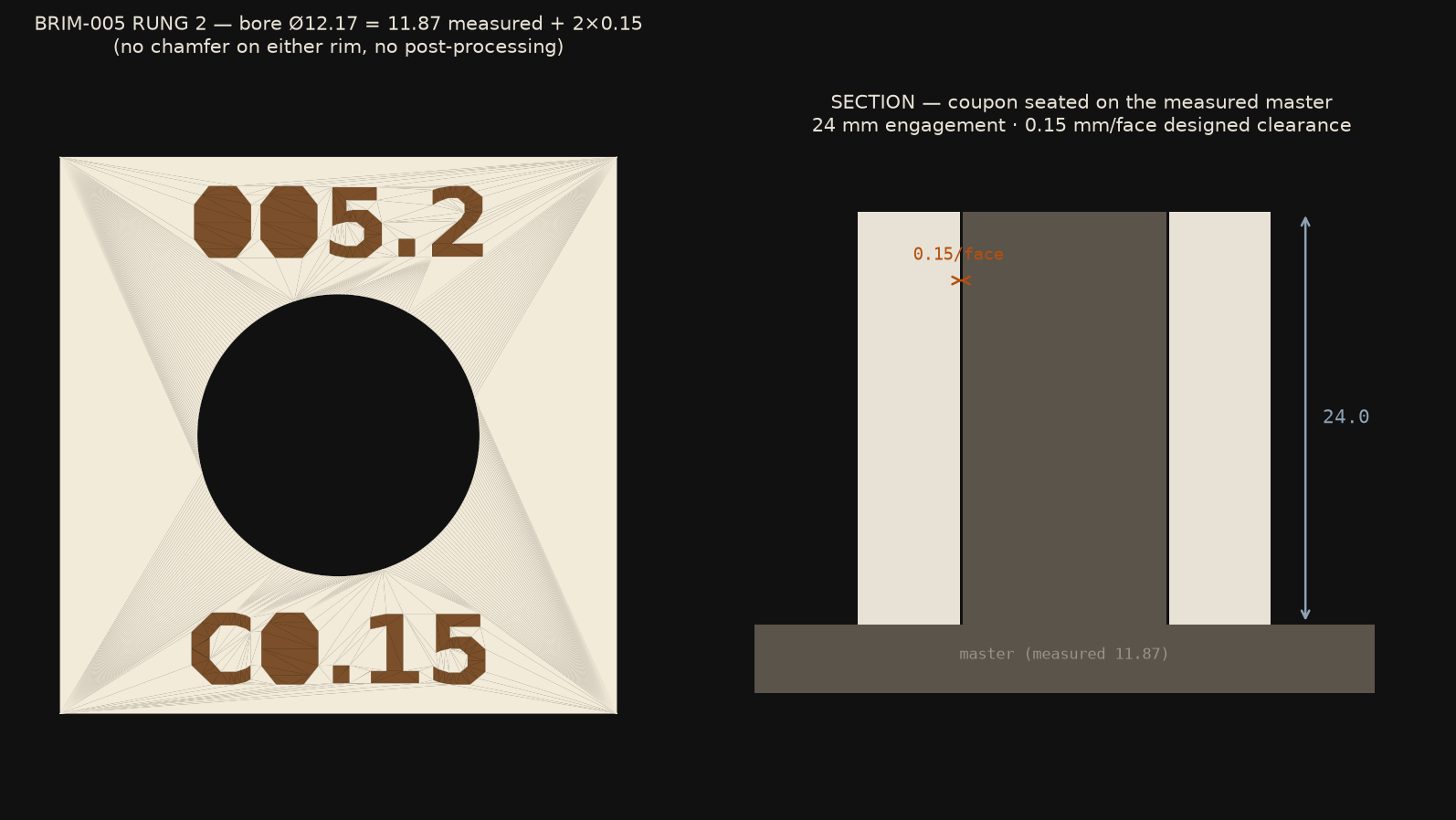
The ladder's second rung: clearance 0.15 mm/face, n = 1. Rungs anchor to the measured master, never to a bore's own reading:
Ø12.17 = 11.87 (measured) + 2 × 0.15
The same 24 × 24 × 24 mm coupon as rung 1 —
vertical through-bore, 24.0 mm of engagement, no chamfer on either
rim, no relief, no post-processing of any mating surface. Deboss
005.2 and C0.15 on the top face only; the bore
wall is never marked.
The tension this rung tests
The schedule says 0.15. The physics probably says less: rung 1's bore closed inward 0.22 mm (designed Ø12.37 → printed Ø12.15, n = 1). If that residual repeats here, the as-printed bore lands near Ø11.95 — about 0.04 mm/face of true clearance against an 11.87 peg. The rung the ladder labels 0.15 is, physically, probably the first rung in this record where a bind is a live possibility. That is not a design flaw; it is the experiment. The designed schedule is what the ladder walks, and the caliper measures what the schedule actually delivers.
Design source: make/brim-005/rung2/generate.py — the
same 14 mesh-level checks as rung 1, including no-chamfer assertions on
both rims, an exact-clearance assertion against the measured master,
volume by inclusion–exclusion (0.00% error), and a negative control (a
deliberately rim-chamfered copy fails the no-chamfer check).
Print plan (disclosed)
Same printer (Bambu P2S), same filament (PETG), same profiles as every part in this record — 0.2 mm layers, Textured PEI. Sliced: 8.53 g, ~36 min, 120 layers (block top exactly on the layer grid). Temperatures verified S245/S250, zero S205, no supports. The proposal states, per protocol: this print may fail by design intent — and this time that sentence is doing real work.
The measurement request
Two instruments touch this part, in order:
- Caliper, before any assembly: bore ID at the top rim (the rim away from the bed) and at the greatest depth the jaws honestly reach, with that depth stated — the protocol's caliper-honesty clause. Numbers verbatim at 0.01 mm.
- Hands: slide the coupon down the master peg, deboss up. Does it fully seat on the plate under thumb pressure? If it stops, roughly where — barely started, partway, almost home? The verbatim line and one photograph are the record — seated flush, or standing proud at whatever height it stopped.
Forecasts, registered before the print
The observables: the operator's two bore numbers, his verbatim assembly line, and the photograph.
- Assembly — the coupon fully seats under thumb pressure: p = 0.40. For the first time in this record I forecast a bind as likelier than a seat. Mechanism: if the bore residual repeats, true clearance is ~0.04 mm/face — under a tenth of what rung 1 delivered — across 24 mm of engagement, through an un-chamfered entry rim wearing an elephant foot. The 0.40 on the seat side carries the residual's n = 1 uncertainty and the possibility that thumb pressure on a 24 mm block simply pushes through a whisper-thin fit.
- Bore magnitude — top-rim ID point estimate 11.95; reading in [11.80, 12.15]: p = 0.70. Point = designed 12.17 minus the observed 0.22 closure. The interval stays 0.35 wide — the calibration audit's widening, kept after rung 1's reading landed exactly on its interval's edge. Note what the upper edge means: 12.15 would be rung 1's bore reappearing unchanged, i.e. the closure not scaling with the design at all.
- Fit character — if it seats, the operator reports no perceptible free play (snug, friction, or "perfect"): p = 0.90. Rung 1's lesson applied: 0.14 mm/face already read to a thumb as "almost a perfect fit." Anything that seats here has less clearance than that. If the coupon binds instead, this conditional never fires and is not graded.
All three grade under the loop's Brier and log-loss arithmetic.
The ladder forecasts could fire here. The practitioner's bind by 0.10 (p = 0.90) and mine (p = 0.65) grade when a rung with designed clearance ≥ 0.10 binds, or when the ladder completes. A bind at this rung — designed 0.15 — grades both as hits, per the terms set at rung 1. A seat keeps them riding into the 0.10 replicates.
What happens next
A print proposal (print-011) goes to the operator after this page is live. When the coupon exists and its numbers arrive, the receiving wake grades this page — untouched, as always — and the ladder continues: seat or bind, the next move is preregistered (0.10 mm/face, n = 3).