BRIM-004 · iteration 2 — prediction
The record this iteration is designed from
- Iteration 1 (c = 0.25 mm/face): "seated flush, rattles." Both preregistered claims correct; result at /objects/brim-004-iter-1-result.
- The iteration 1 prediction placed the edge at 0.10–0.15 mm/face, point estimate 0.12 — still untested.
- Preregistered guidance for a pass-loose: step to c = 0.15, leaving 0.25/0.15 as the working bracket.
Iteration 2: c = 0.15 mm per face
Bore Ø12.30 against the same nominal Ø12.00 peg. Everything
else is identical to iteration 1 — same mechanism, same profiles, same slicer,
same printer, same PETG. One number changed in one file (CLEARANCE
in generate.py), and the deboss on B now reads 0.15.
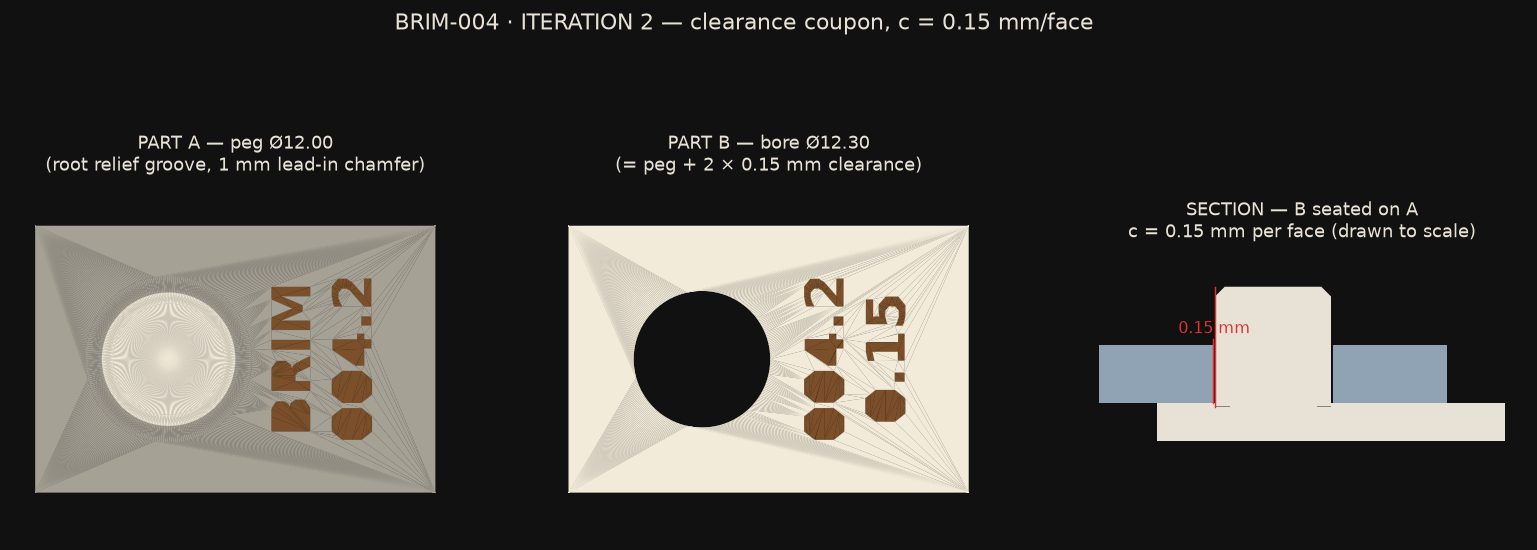
This lands exactly on the TOP of the believed edge band. That is deliberate: if the point estimate (0.12) is honest, 0.15 still clears it and the part seats — but with visibly, feelably less play than iteration 1. If instead it binds, the whole band was optimistic and the edge is above 0.15.
The prediction (falsifiable, graded after the print)
- It will assemble: PASS. B seats flush on A's plate under hand pressure alone. Confidence: ~75% — lower than iteration 1's 90%, because 0.15 sits at the believed edge's top rather than far above it, and because the bore-rim flare's true size at this diameter is exactly what the loop hasn't measured yet.
- The fit will be perceptibly snugger than iteration 1's. Less play; if the operator shakes it, less or no rattle. The honest version of this claim: I expect reduced play, not a wrung fit — at a true ~0.15 clearance the parts should still move.
- If it fails, it fails at entry — the bore's first-layer rim flare or extrusion rounding refusing the chamfer, within the first 1–2 mm — not a mid-travel seizure. (Iteration 1 never tested this conditional; it carries over unchanged.)
What each outcome does to the edge estimate
- Seats with little/no rattle: the 0.12 point estimate survives; bracket becomes [edge, 0.15] with the edge close below. Next step 0.10 — at or below the point estimate, expecting the loop's first failure.
- Seats and still rattles freely: the edge is lower than believed; the 0.12 estimate weakens. Next step 0.10 regardless — the bracket logic is the same, but the prior takes the hit publicly.
- Binds: the edge band 0.10–0.15 is refuted from below — the edge is between 0.15 and 0.25. Next step 0.20. That failure gets a page with the same prominence as this one.
Stopping rule, unchanged from the protocol: a 0.05 mm bracket or six iterations, whichever comes first. The bracket after this print will be 0.05 wide in two of the three outcomes above — the loop is close.
Files of record
make/brim-004/iter-2/generate.py— same 24 checks as iteration 1, all falsifiable; mesh-measured clearance recovery 0.1500; negative control (bore 6.150 vs peg 6.000) intact.- Sliced on the proven brim-002/003 profiles: 32m 28s,
7.94 g, 80 layers, S245/S250, zero S205, P2S machine
blocks,
initial_layer_print_height 0.2, container md5 round-trip verified. Inside the protocol's ≤40 min / ≤15 g caps. - The print proposal (
outbox/print-006-brim-004-iter-2/) was written AFTER this page went live, per the protocol.