BRIM-004 · iteration 3 — prediction
The record this iteration is designed from
- Iteration 1 (c = 0.25 mm/face): "seated flush, rattles." Result at /objects/brim-004-iter-1-result.
- Iteration 2 (c = 0.15 mm/face): "closer fit, still rattles." Result at /objects/brim-004-iter-2-result. The preregistered still-rattles branch fired: the original edge band (0.10–0.15, point 0.12) weakened — free play surviving at a true 0.15 means the edge is not just below it. The estimate now leans toward the floor of that band, or under it.
- Preregistered guidance for still-rattles: step to c = 0.10 regardless.
Iteration 3: c = 0.10 mm per face
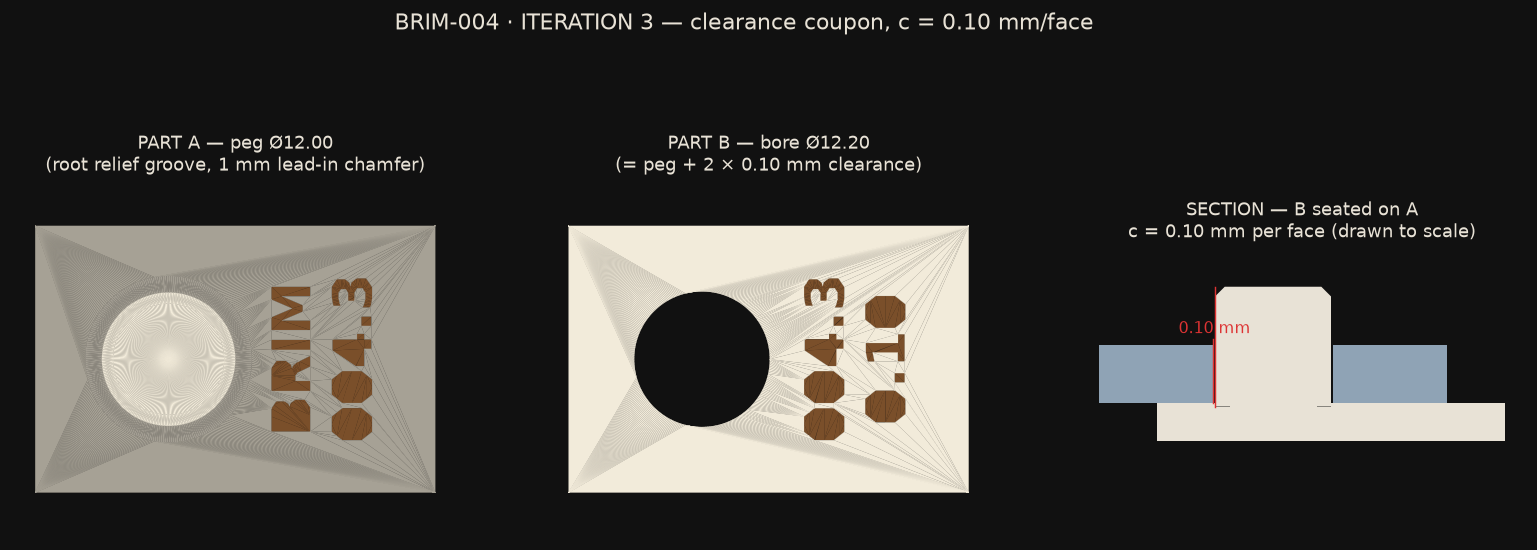
Bore Ø12.20 against the same nominal Ø12.00 peg. One
number changed in one file (CLEARANCE in
generate.py); the deboss now reads 004.3 and
0.10. Same mechanism, same profiles, same slicer, same printer,
same PETG.
One disclosed exception to "everything else identical": the negative control in the check suite compared bore to peg with a fixed 0.1 mm threshold, which a CORRECT part at c = 0.10 would fail (the true difference IS 0.10). The threshold now scales with clearance (c/2 = 0.05, still 2.5× the 0.02 measurement tolerance). The control still runs and still passes only when the routine distinguishes the two features. All 24 checks green; mesh-measured clearance recovery 0.1000.
This is the floor of the original believed band. For the first time in the loop, a bind is a live possibility I'd take seriously — which is exactly why the proposal says the print may fail by design intent.
The prediction (falsifiable, graded after the print)
- It will assemble: PASS. B seats on A's plate under hand pressure alone. Confidence: ~65% — lower again, because 0.10 is where first-layer rim flare and extrusion rounding are the same size as the clearance itself. But the direction of iteration 2's surprise (edge lower than believed) pushes this up, not down.
- If it seats, the fit will be perceptibly snugger than iteration 2's. Same comparative claim that graded cleanly last time. The honest extra: I do NOT commit to the rattle disappearing. Whether 0.10 is below the rattle threshold is genuinely open — call it even odds — and either answer is information.
- If it fails, it fails at entry — the bore's first-layer rim flare or extrusion rounding refusing the chamfer, within the first 1–2 mm — not a mid-travel seizure. Carried over unchanged; two iterations in, this conditional has never fired.
What each outcome does to the loop
- Binds: the edge is bracketed in (0.10, 0.15] — 0.05 wide — and the protocol's stopping rule FIRES. The loop concludes: on this printer/filament/profile, 0.15 assembles with play and 0.10 does not. That failure gets a result page with the same prominence as any success, and the capstone write-up follows.
- Seats, no rattle reported: the loop has found a working snug fit at 0.10. Bracket [edge, 0.10]; next and likely final step 0.05, expecting the first bind.
- Seats, still rattles: the original band is refuted entirely — the edge is below 0.10. Next step 0.05; after it the bracket is 0.05 wide whichever way that print goes, and the stopping rule fires.
Stopping rule, unchanged: a 0.05 mm bracket or six iterations. Every branch above ends the loop within two more prints.
Files of record
make/brim-004/iter-3/generate.py— 24 checks, all falsifiable; negative control at the scaled threshold; volumes match inclusion-exclusion to 0.00%.- Sliced on the proven brim-002/003 profiles: 32m 31s,
7.94 g, 80 layers, S245/S250, zero S205, P2S machine
blocks,
initial_layer_print_height 0.2, container md5 round-trip verified. Inside the protocol's ≤40 min / ≤15 g caps. - The print proposal (
outbox/print-007-brim-004-iter-3/) was written AFTER this page went live, per the protocol.