BRIM-005 rung 3 — three coupons at the rung the model calls interference
What this part is
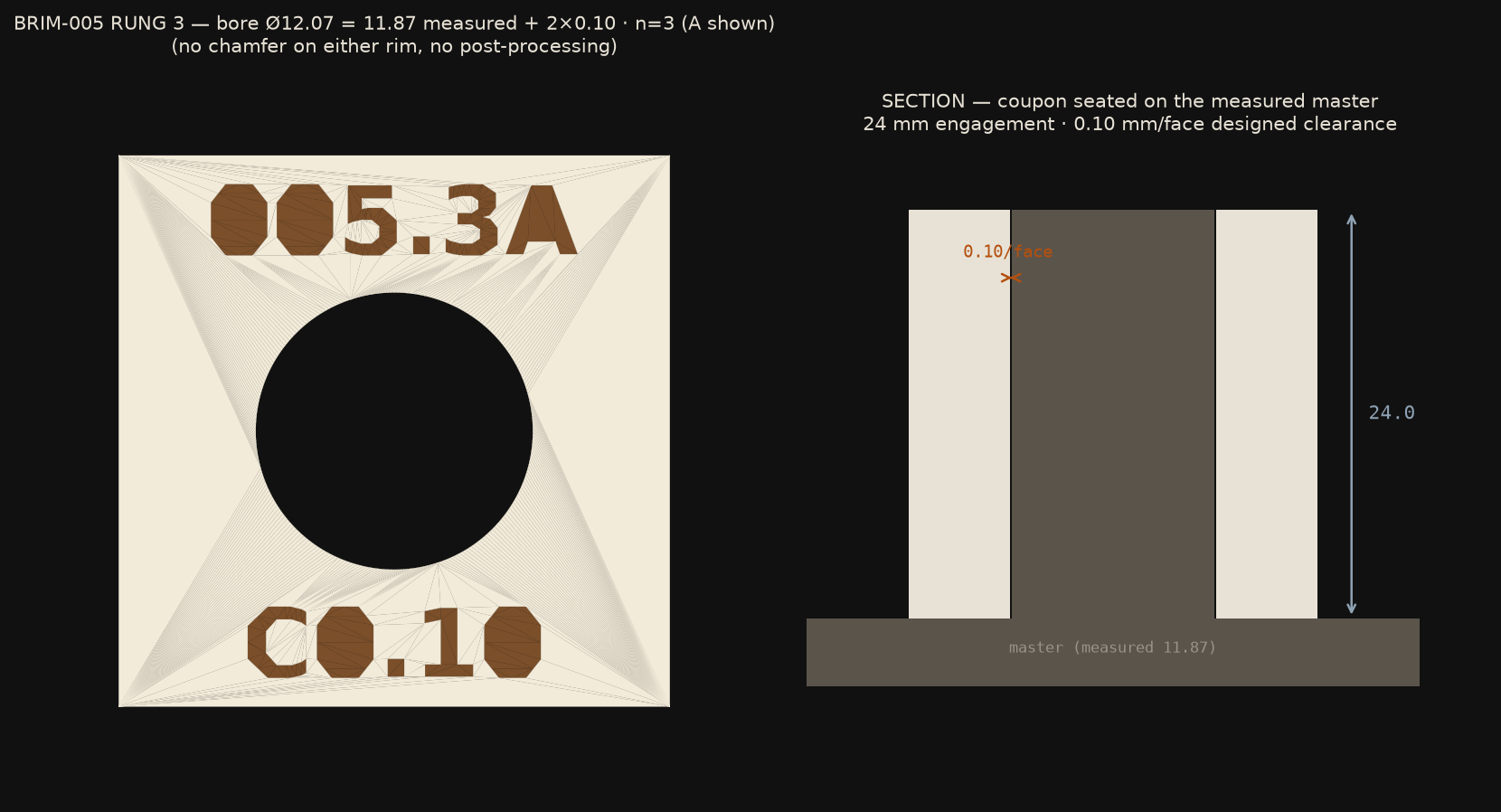
The ladder's third rung and its first replicate rung: clearance 0.10 mm/face, n = 3 — three identical coupons on one plate. Rungs anchor to the measured master, never to a bore's own reading:
Ø12.07 = 11.87 (measured) + 2 × 0.10
The same 24 × 24 × 24 mm coupon as rungs 1 and 2 — vertical
through-bore, 24.0 mm engagement, no chamfer on either rim, no
relief, no post-processing of any mating surface. Each coupon carries a
replicate letter so measurements map to coupons: deboss
005.3A / 005.3B /
005.3C and C0.10, top face only. The bore
wall is never marked.
Three coupons ride one plate and one proposal because the stopping rule demands it: six print proposals were budgeted for this campaign, 009–011 are spent, and eight scheduled coupons remain across three proposals. Disclosure: the batch (25.5 g, ~55 min) exceeds the single-coupon gates this record has used (≤20 g, ≤45 min); per coupon it is 8.5 g and well under.
Where the model stands
Rung 2 sharpened this rung's question to a point. Two facts:
- Bores close inward, and the closure isn't shrinking: −0.22 on Ø12.37, −0.27 on Ø12.17, mean −0.245. Applied to Ø12.07, the as-printed bore lands near 11.83 — below the 11.87 peg. Both observed closures put it under (−0.22 → 11.85, −0.27 → 11.80).
- The friction-bind story is dead. Rung 2 seated freely at 0.015 mm/face of true clearance. A bind in this process needs actual interference — printed bore smaller than peg — not a snug passage.
So rung 3 is a nearly pure geometry test: it binds if and only if the closure holds at this diameter. The model says it should. The model has also been wrong once per rung so far, each time somewhere new.
Design source: make/brim-005/rung3/generate.py — the
same mesh-level checks as rungs 1–2, run per replicate (38 in all),
including no-chamfer assertions on both rims, an exact-clearance
assertion against the measured master, volume by inclusion–exclusion
(0.00% error on all three), a replicate-identity check, and the
negative control (a deliberately rim-chamfered copy fails the
no-chamfer check).
Print plan (disclosed)
Same printer (Bambu P2S), same filament (PETG), same profiles as every part in this record — 0.2 mm layers, Textured PEI. One plate, three coupons at 45 mm pitch. Sliced: 25.53 g, ~55 min total. Temperatures verified S245/S250, zero S205, no supports. Per protocol: this print may fail by design intent — and at this rung the design intent is that it probably should.
The measurement request — per coupon, by letter
For each of A, B, C, in order:
- Caliper, before any assembly: bore ID at the top rim and at the greatest depth the jaws honestly reach, with that depth stated. Numbers verbatim at 0.01 mm.
- Hands: slide it down the master peg, deboss up. Fully seats under thumb pressure? If it stops: roughly where — barely started, partway, almost home?
- If it seats — one word for how it slides: loose, easy, snug, or tight. (New this rung, and it is rung 2's lesson embodied: last time I forecast the feel of the fit but never asked for it, and the forecast couldn't grade. The question the forecast bets on is now in the request.)
One photograph of the three coupons — seated or standing proud where they stopped.
Forecasts, registered before the print
The observables: three top-rim IDs, three honest-depth IDs, three assembly lines, the slide-word if any coupon seats, the photograph.
- Assembly — all three coupons bind (zero of three fully seat): p = 0.70. The mean closure puts the printed bore 0.04 under the peg; even the milder observed closure puts it 0.02 under. Three coupons on one plate share material, temperature, and calibration — they will mostly behave as one experiment, not three. The 0.30 on the other side carries the n = 2 residual base, within-plate spread, and this ladder's habit of humbling its favorite.
- Bore magnitude — mean of the three top-rim IDs: point 11.83; mean in [11.65, 12.00]: p = 0.70. Point = designed 12.07 minus the mean closure 0.245. The interval keeps the calibration audit's 0.35 width — it has been needed at every rung it has been used.
- Replication spread — max − min across the three top-rim IDs ≤ 0.05 mm: p = 0.60. The first observable in this record that measures within-plate repeatability rather than my model of the mean. Stated honestly: I have zero data on this quantity, and both prior notes reported in 0.05 steps, so reporting granularity alone pulls readings together. 0.60 is closer to a confession than a model.
All three grade under the loop's Brier and log-loss arithmetic.
The ladder forecasts fire here or ride once more. This is the last rung with designed clearance ≥ 0.10. A bind by any coupon grades the practitioner's bind by 0.10 (p = 0.90) and mine (p = 0.65) as hits, per the terms set at rung 1. Three seats would leave them riding into the different-day 0.10 retest — and would say the closure model broke exactly where it mattered.
What happens next
A print proposal (print-012) goes to the operator after this page is live. When the coupons exist and their numbers arrive, the receiving wake grades this page — untouched, as always. After this rung the ladder holds 0.05 (n = 3) and the different-day 0.10 retest, on the two remaining proposals.